
Factory Acceptance Test (FAT): what it is, when it is done and how it is passed
The FAT is the formal test of a machine at the supplier’s factory, with the customer present and before shipping. We explain what is checked, in what order and what passing it means, and we describe the FAT of a filling and capping monoblock we ran for GLEBA.
By Federico Comacchio · Ingeniero Mecánico — UTN Buenos Aires
What a FAT is
FAT stands for Factory Acceptance Test. It is the formal test in which the manufacturer shows the customer, at the manufacturer’s own plant and before shipping, that the machine meets what was agreed in the specification.
It is not a sales demonstration or a start-up. It is a documented, point-by-point verification against a protocol agreed in advance. Each item is tested, recorded and signed off.
The logic is simple: a problem found at the supplier’s factory is fixed in hours, with the tools, spare parts and technicians who built the machine. The same problem found at the customer’s plant, with the machine already installed, costs days of line downtime.
When it is done and who takes part
The FAT is carried out once the machine is finished, wired and already tested internally by the manufacturer, and before it is dismantled for packing. It is the last step at the factory.
Within a project, the usual order is: specification and purchase order, design and manufacturing, the manufacturer’s internal tests, FAT with the customer present, shipping and installation, SAT (Site Acceptance Test) at the customer’s plant and, finally, start-up and production.
Two parties take part. For the manufacturer, those responsible for engineering, automation and technical service. For the customer, those who will receive the machine: production, maintenance, quality and safety. It is worth bringing the operators who will run it, because the FAT also works as a first training session.
How it is done
Everything starts from the FAT protocol: a document the manufacturer prepares and the customer approves before the day of the test. It defines what is tested, by which method, with which instrument and what the acceptance criterion is for each point. Without a written criterion there is no way to say whether a result passes or not.
The test moves from static to dynamic:
- Document review: electrical and pneumatic drawings, manuals, component list and material certificates.
- Inspection with the machine stopped: the equipment is compared with the specification (dimensions, product-contact materials, component brands, finishes and labelling of cables and control panel).
- Safety: emergency stops, door interlocks and guards, one by one.
- Dry run: movements, sensors, alarms and HMI screens, with no product.
- Test with product and containers: the machine runs in conditions as close as possible to the real ones.
- Close-out: the results are reviewed and the report is signed.
What is checked on a filling machine
On a filling machine, the test with product is the core of the FAT. This is what is measured:
Ideally the test is run with the customer’s real product and containers. When the product is hazardous or cannot be transported, a liquid of similar density and viscosity is used, and the final verification with real product is left for the SAT.
- Filling accuracy: a series of containers is weighed on a calibrated scale and compared with the agreed tolerance.
- Repeatability: the spread between consecutive containers and between nozzles is measured.
- Speed: containers per minute are counted in sustained operation, not at an isolated peak.
- Format changeover: the machine is switched from one container to another and the changeover is timed.
- Recipes: each product is loaded from the HMI and the machine is confirmed to take the parameters.
- Clean filling: no dripping, no foam out of range, no spills on the container.
- Alarms and faults: missing container, missing product, misplaced container and low air pressure are simulated.
What passing it means
A passed FAT means the customer accepts that the machine meets the specification and authorises shipping. This is recorded in a report signed by both parties, with the results of each test. The report can close in three ways:
In many contracts a passed FAT is also a commercial milestone: it releases the shipment and the associated payment.
- Passed: every point complies.
- Passed with open items: there are minor observations, recorded on a punch list with an owner and a date. They are resolved before shipping or, if agreed, at the SAT.
- Not passed: a critical point does not comply. It is corrected and the test is repeated.
FAT and SAT are not the same
The FAT does not replace the SAT. Transport, assembly and plant utilities (air, power, product supply) can change how the equipment behaves, and that can only be checked on site.
The most widely cited international reference is IEC 62381, which defines requirements and checklists for FAT and SAT in automation systems. In packaging machinery, the scope of the test is set by the contract between manufacturer and customer.
- Where: the FAT takes place at the supplier’s factory; the SAT, at the customer’s plant.
- When: the FAT, before shipping; the SAT, after installation.
- What it proves: the FAT, that the machine meets the specification; the SAT, that it works integrated into the line, with the real utilities and product.
- What it releases: the FAT, the shipment; the SAT, final handover and the start of the warranty, depending on the contract.
Why it matters
The FAT gives the customer the certainty of receiving a machine that has already been tested, not one that is still being adjusted at their plant.
- Less risk: deviations show up where they are cheapest and quickest to correct.
- Shorter start-up: the machine arrives with its parameters already set for the customer’s products and containers.
- Trained operators: those who attended the test already know the machine before it arrives.
- Documentary backing: the report and test records become the baseline for the SAT, maintenance and quality audits.
A real case: the FAT of a monoblock for GLEBA
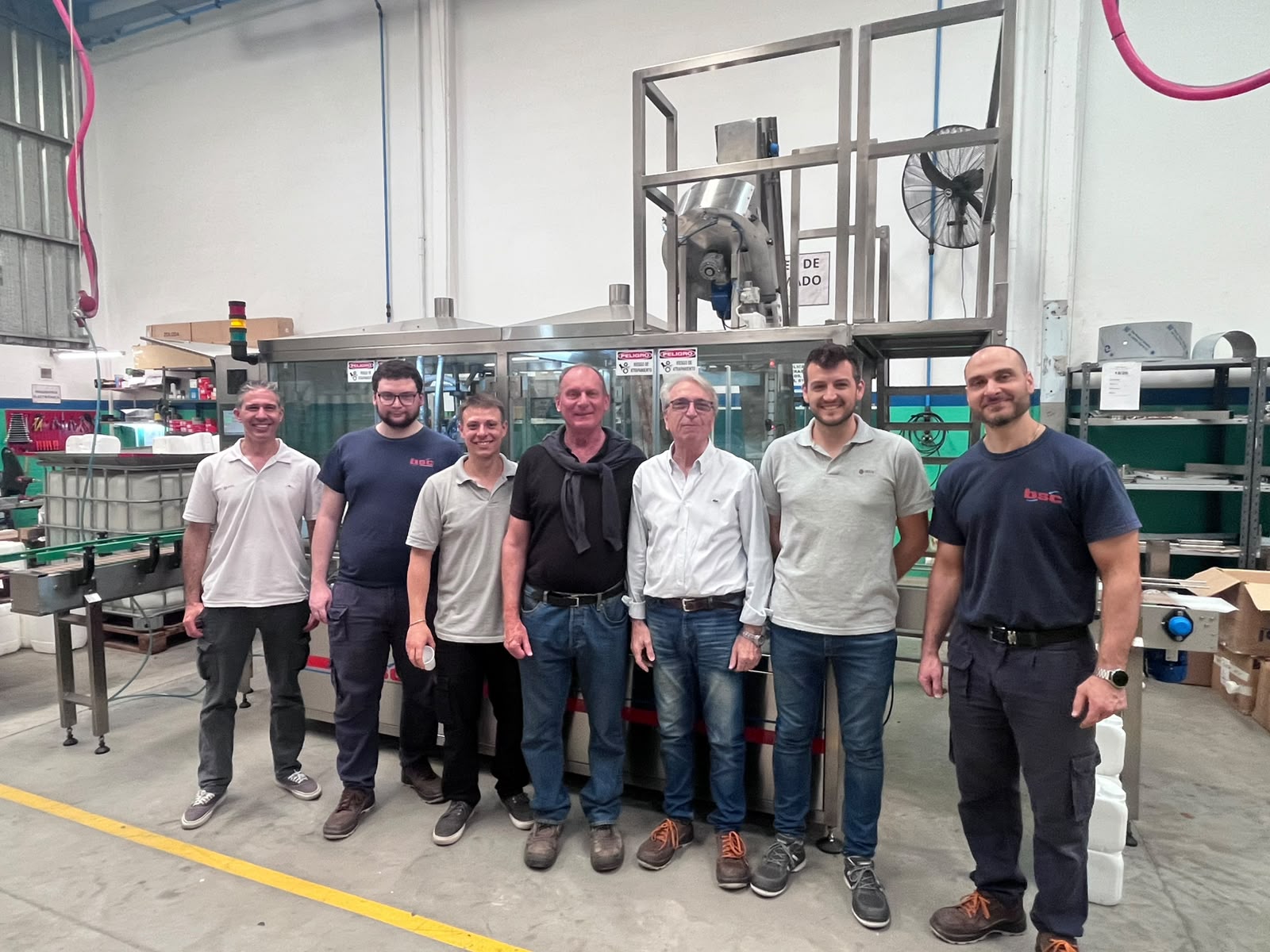
On 20 November 2026 we carried out, at our plant in Caseros, the FAT of a filling and capping monoblock built for GLEBA. The report was signed by both parties, with the operating points tested found compliant.
The machine, an MLLT 3+1 monoblock, combines three filling nozzles and one capping head on a single frame. It is intended for packaging agrochemicals and handles three formats: 1, 5 and 20 litres.
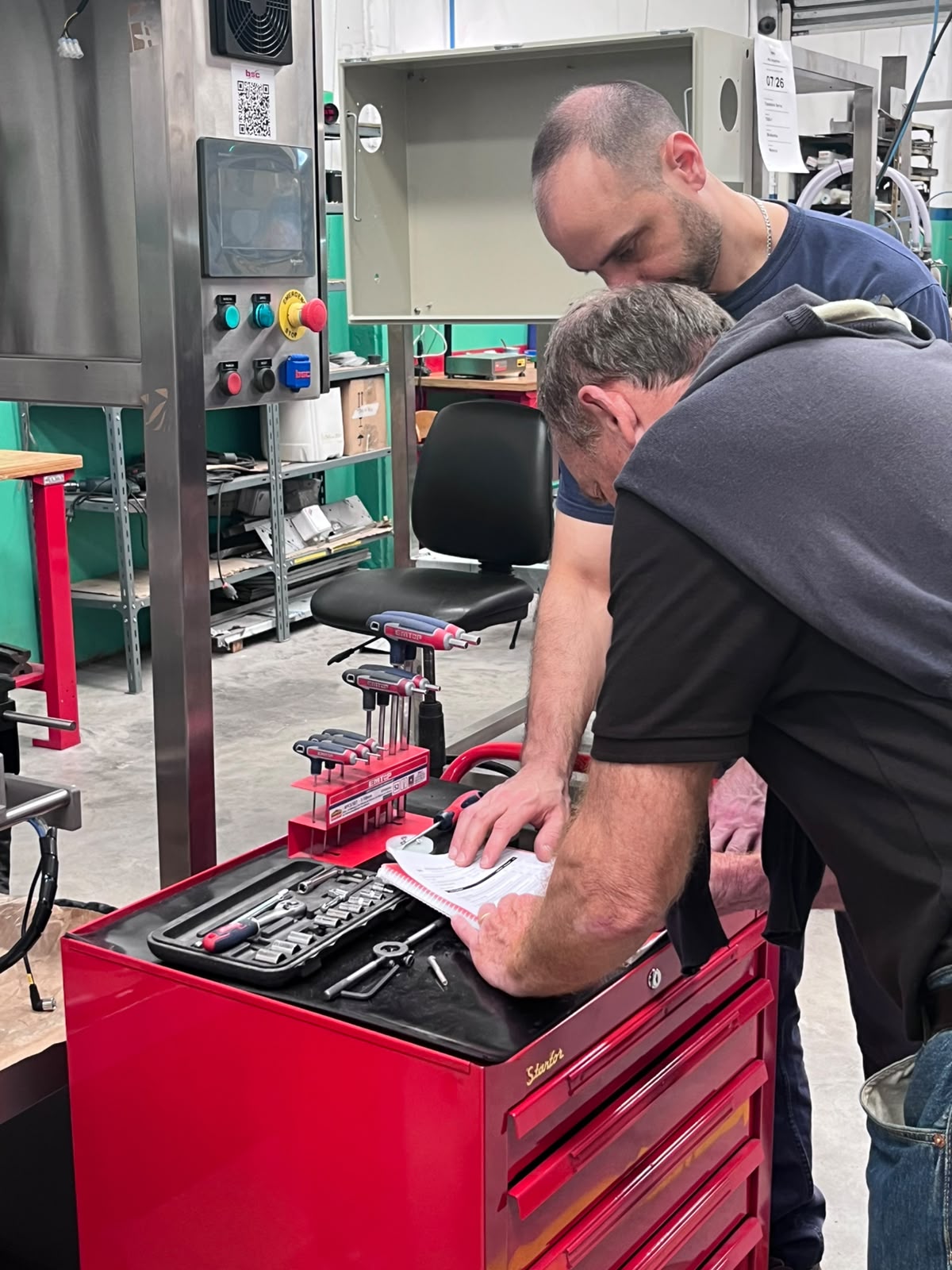
GLEBA was represented by those responsible for production and maintenance: the people who will operate the machine and those who will maintain it. They went through the protocol with BSC’s technical team, point by point.
The dynamic test was run with water. This is standard practice with hazardous products such as agrochemicals, which are not handled at the supplier’s factory: it allows the mechanical operation, container transfer, capping and the joint work of the two stations to be verified. Filling calibration and accuracy, torque adjustment and continuous-run output were not part of this test: they are set with the real product.
With the test closed, the monoblock enters the final stage before shipping to GLEBA’s plant. These were the points verified and found compliant:
- General inspection and utilities: power supply, compressed air and a tidy, leak-free installation.
- Mechanical check: manual adjustments free of interference and a dry run with no noise or knocking.
- Input signals: every sensor, push-button and door reads correctly on the HMI.
- Commands: every actuator (nozzles, tray, conveyor) responds to the HMI command.
- Containers and formats: format changeover and transfer of each container with no jams or tip-overs.
- Capping: correct, repeatable closures.
- Filling-capping synchronisation: the transfer between stations causes no accumulation, tip-overs or spills.
Frequently asked questions
What does FAT stand for?+
Factory Acceptance Test. It is the formal verification of a machine at the manufacturer’s plant, with the customer present and before shipping.
Does the FAT replace the SAT?+
No. The FAT proves the machine meets the specification at the factory. The SAT proves it works installed in the customer’s line, with their utilities and product.
Who should attend on the customer’s side?+
Those who will receive the machine: production and maintenance at least, and quality or safety depending on the case. It is worth sending the people who will operate it.
Which product is used for the test?+
Ideally the real product and containers. If the product is hazardous or cannot be transported, water or another liquid with similar properties is used, and the adjustments that depend on the product are completed at the customer’s plant.
What happens if an observation comes up?+
It is recorded in the report with an owner and a date. Minor ones are resolved before shipping or at the SAT. If the point is critical, it is corrected and the test is repeated.
Which documents remain after a FAT?+
The protocol with the result of each point and the report signed by both parties. They are the baseline for the SAT and for later maintenance.
Want us to review your case?
Tell us about your product, container and required output. We suggest a configuration and you can test your product on our testing bench.